
The Jack and Acton Project
Welcome to the Jack and Acton Project. This three-year research project will study the 48,000 fragments of red earthenware ceramics recovered from the 1714-1775 Parker-Harris Pottery site during archaeological excavations conducted ahead of the "Big Dig" in the 1980s.
The pottery was established in 1714 when Isaac Parker and his wife Grace purchased a lot of land southwest of what is now City Square Park in Charlestown. The couple had 11 children while also developing the largest pottery in Charlestown. After Isaac died in 1742, Grace continued to run the business until her death in 1754. Potter Josiah Harris took over the pottery until it was burned by British soldiers during the Battle of Bunker Hill on June 17, 1775. Today, the tunnel connecting the Zakim Bridge off-ramp to the Tobin Bridge runs through the site's former location.
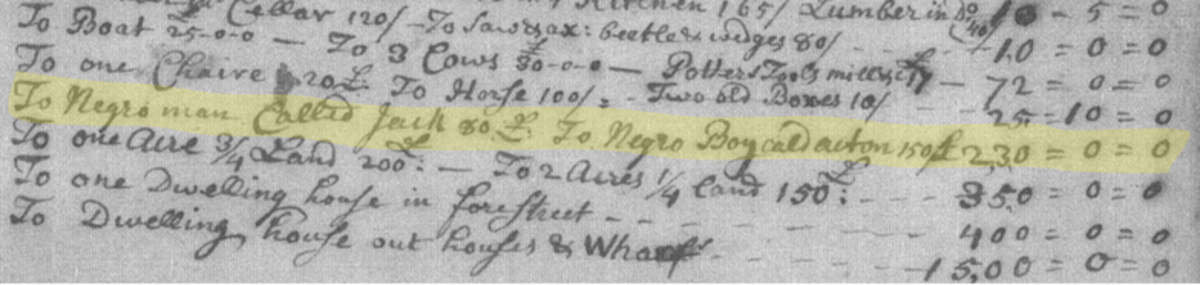
Isaac Parker's 1742 probate inventory listing Jack & Acton as property worth a combined value of £230.
An estate inventory recorded at Isaac’s death lists two enslaved Black people: a man called Jack and a boy called Acton. Their combined value of £230 was considerably higher than other enslaved people at the time. Historian and slavery expert Jared Hardesty has identified Jack and Acton as artisan potters given their exceptional value and their presence in Parker's pottery inventory. The only other information about the pair comes from the vital records in Charlestown, which state “Jack, Negro servant to Grace Parker, & Flora, servant to Joseph Gowen, m. by Rev. Mr. Hull Abbot, Dec. 16, 1742.” No other documentation of Jack or Acton have been found.
Many hundreds of enslaved people were integral to the 19th-century ceramics industries in the southern U.S. including David Drake of Edgefield, South Carolina, also known as “Dave the Potter." Other known Black potters of the 19th century include Thomas W. Commeraw, a free man working in New York City. Jack and Acton are two of the only named 18th-century enslaved potters yet identified.
With thousands of fragments of pottery from the site where Jack and Acton worked, this re-analysis of the collection provides an opportunity to explore, understand, and celebrate Jack and Acton’s impacts on the pottery production at the site as well as their overall artistic contributions to the art of ceramics in the United States.
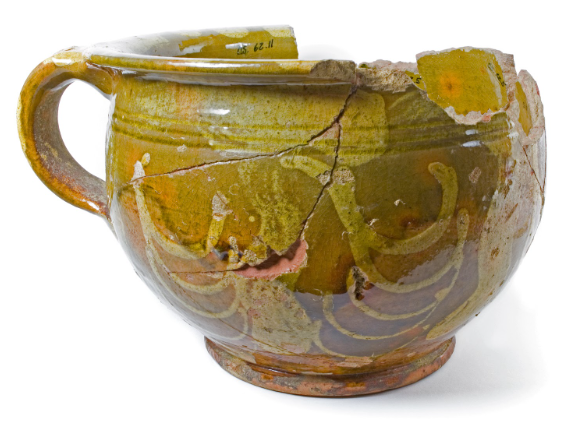
A chamber pot found at the Three Cranes Tavern in Charlestown featuring the distinctive "swags and bars" characteristic of Jack and Acton's work at the Parker Pottery.
In 1986, archaeologists excavated the Parker Pottery site after their research suggested that it may have survived over two centuries of development. The original excavators did not create a complete artifact catalog and only studied 645 pottery fragments, just 2.54% of the total found. Jack and Acton were never mentioned in the archaeological report. Our continuation and completion of this analysis will provide exciting new insights insights into the works of these early 18th-century artisans and the reach of their influence in the ceramic market.
To date, Jack and Acton's distinctive “bars and swags” decorations have been found as far north as Fortress Louisbourg in Nova Scotia, nearly 600 miles away from Charlestown by boat. The southern range of their ware distribution has yet to be determined. The three-year Jack and Acton Project will begin with a complete re-cataloging of the ceramics from the site, including individual vessel types, forms, and decorations. This data will be used to create a guidebook for the identification of Jack and Acton’s wares across the east coast, and potentially beyond.
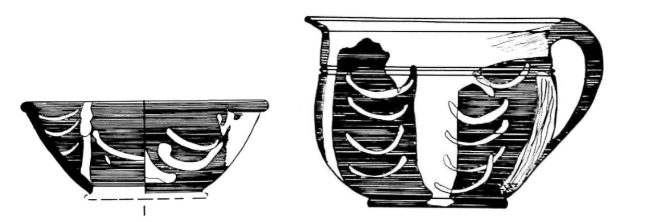
Scientific illustrations of a bowl and chamberpot found at Fortress Louisbourg with “swags and bars” decorations characteristic of the Parker Pottery. Image Credit: Kenneth James Barton, 1981, Coarse earthenwares from the Fortress of Louisbourg, Parks Canada.
The City Archaeology team is excited to partner with Kyera Singleton, Executive Director of the Royall House and Slave Quarters in Medford, Massachusetts. Together, they will examine the Royall House's archaeological collection to identify Jack and Acton's wares among their ceramics assemblage. This work will culminate in exhibits at both the City Archaeology Lab and the Royall House and Slave Quarters, as well as a public symposium focused on enslaved craftspeople and their labor.
Local redware potter and historian, Rick Hamelin, will serve as an advisor on the technical aspects of pottery production and decoration. As part of the symposium, he will develop and deliver a public program demonstrating some of the techniques Jack and Acton would have used to produce their pottery. The symposium will take place in 2027. Updates to follow.
-
Still have questions? Contact:
Archaeology
-
 201 Rivermoor Street
West Roxbury, MA 02132


-
Still have questions? Contact:
Archaeology
-
201 Rivermoor Street
West Roxbury, MA 02132
