
Safe Nail Salons
Nail salon workers face exposure to hazardous chemicals through their work. Safe Shops works with 200+ nail salons in Boston to prevent or reduce exposure to these chemicals while at work.
We offer free training and technical assistance for nail salons to improve health and safety. Our staff help salon owners find solutions to health risks like improved ventilation and proper use of personal protective equipment. They can also help answer questions about regulations.
To schedule an education and outreach visit to your salon, please contact us at 617-534-5965 or EHoutreach@bphc.org. We are able to provide services in English and Vietnamese.
-

-
Questions? Contact us:
-
 1010 Massachusetts Ave.
2nd Floor
Boston, MA 02118


Ventilation Requirements
All Boston nail salons must comply with minimum ventilation specifications listed here.
To demonstrate compliance:
- Salons must submit a completed Boston Public Health Commission ventilation checklist, stamped by a licensed mechanical engineer
- A mechanical engineer's report showing that ventilation systems meet requirements
Required ventilation includes:
- Mechanical ventilation exhausts fumes outside (0.6 CFM/FT²)
- Mechanical ventilation brings air into the salon (0.12 CFM/FT² + 20 CFM/occupant)
- Makeup air and exhaust air ducts are separate
- Source capture at manicure tables and foot baths (able to exhaust a minimum of 50 CFM per station)
Source capture takes in air where services take place, such as a manicure or pedicure station, and exhausts it out of the salon. This air cannot mix with salon air or recirculate into the salon space. Learn about source capture compliance here.
Nail Salon Training Video
The Safe Shops Program worked with VietAID to produce a video to help workers better understand how to protect themselves from chemical exposure in their workplace.
Regulation, Application, and Checklist Documents
Important DocumentsBoston Public Health Commission Nail Salon Regulation
All nail salons must comply with the practices in the Nail Salon Regulation. They are available in English here.
Boston Public Health Commission Nail Salon Regulation Guidelines
These guidelines explain how to follow the Boston Public Health Commission Nail Salon Regulation. They are available in English and Vietnamese.
Boston Public Health Commission Nail Salon Regulation Training
Like the Guidelines, this is paired with the Nail Salon Regulation to increase practical understanding. It is available in English here. You may view the training in English here. For any questions, or to schedule a training at your salon, please contact us at 617-534-5965 or EHoutreach@bphc.org.
Every nail salon must renew their Boston Public Health Commission Nail Salon Permit annually. The permit application is available in both English and Vietnamese, for:
All nail salons must hang the Public Health Notice in their salon, where customers can easily see it. The Notice describes rules for sanitary salon conditions that customers should be aware of. It is available here.
This document lists what the Environmental Health Inspectors look for during nail salon inspections. We recommend that nail salons use this checklist once per week to ensure you are compliant with the Nail Salon Regulation. It is available in English and Vietnamese.
Nail Salon ventilation
All nail salons must comply with ventilation requirements as outlined in the 2015 International Mechanical Code as incorporated into the Building Code by October 17, 2018. New nail salons (salons that have never received a permit with the Boston Public Health Commission Environmental Health Office) must comply immediately in order to receive their Nail Salon Permit. The International Mechanical Code requires intake and exhaust ventilation, including ventilation at the point of service (the manicure table or pedicure chair).
Click here for some examples of compliant and noncompliant source capture ventilation in nail salons.
Ventilation checklist
All nail salons must comply with ventilation requirements as outlined in the 2015 International Mechanical Code as incorporated into the Building Code by October 17, 2018. New nail salons (salons that have never received a permit with the Boston Public Health Commission Environmental Health Office) must comply immediately in order to receive their Nail Salon Permit. To indicate compliance with the ventilation requirements, nail salons must submit the ventilation checklist completed and stamped by a licensed mechanical engineer, as well as a drawing of the salon's ventilation system produced by a mechanical engineer.
To access a copy of the ventilation checklist, click here. To learn more about required ventilation, read the Ventilation Requirements section above.
Personal Protective Equipment
Personal Protective EquipmentThere are several types of respiratory protection that can be appropriate for nail salon workers. Managers should supply employees with the OSHA Respiratory Protection Standards to ensure proper use of protection.

N95 Dust Mask
- Protects against dust, use when buffing or filing nails
- Does not protect against chemicals
- Only needs to be worn when working on a client

N95 Dust Mask with Odor Control
- Protects against dust and some chemical odors
- Mask has an exhalation valve for easy breathing

Air Purifying Respirators
- Only mask that protects against chemical gasses and vapors
- Types of mask cartridges vary
- Managers should get employees fitted and trained on mask use
* Note that surgical masks are NOT appropriate protection for nail salon workers, as they were designed to prevent transmission of bodily fluids, not from dust or chemical inhalation.
Salon workers can protect their skin with proper hand washing, gloves, and covering open wounds on exposed skin.

Wash your hands:
- Before and after assisting every client
- Before eating, drinking, applying makeup, smoking
- Before and after handling chemicals

Wear gloves:
- Nitrile gloves should be worn during all services
- Replace gloves immediately if there is a tear or hole in them
- Use a new pair of gloves for each client
- Do not use latex gloves because some people have latex allergies and because latex gloves do not protect against chemicals used in a nail salon

Cover cuts and wounds:
- Nail salon workers should cover cuts or open wounds with a bandage
- Cuts and wounds in the skin allow chemicals and other hazards (viruses, bacteria, fungi) to easily enter the body
- Bandages help protect the skin from possible infection
Safety glasses or goggles offer some protection in case of airborne particles, chemical splash, and eye irritation.
Sterilization Tools
Sterilization ToolsThe purpose of a dry heat sterilizer is to sterilize multi-use tools.
Single-use tools can only be used on a single customer before being thrown away. These are tools like buffers, toe separators, and nail files.
Multi-use tools can be used on multiple customers but must be sterilized between uses in a dry heat sterilizer or autoclave. They include tools such as cuticle pushers and nail clippers.
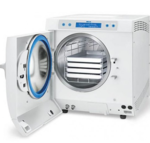
Autoclaves use high heat and pressure to kill all microbial life including bacteria, viruses, and spores. These typically run for 30 minutes at 270°F.
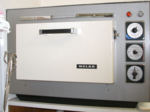
Dry Heat Sterilizers use high heat to kill all microbial life including bacteria, viruses, and spores. These run for one hour at 340°F. The increased time and temperature make this unsuitable for use with tools that have plastic parts.
Salons are required to keep a logbook that shows they are using their dry heat sterilizer or autoclave, and that it is working properly. This information must be available in the salon, as inspectors will look for these documents.
Logbook entries should include:
-
Date and time when tools were sterilized
-
Type of sterilization (autoclave or dry heat sterilizer)
-
Model and serial number of the machine used
-
The actual indicator test strip or tape used during each sterilization cycle.
-
Dry heat sterilizers use an indicator test strip.
-
Autoclaves use autoclave tape.
-
Test strips and tape are put in the machine as tools are sterilized. The test strips and tape will change color when exposed to high temperature and pressure for enough time. They are meant for one-time use.
-
Brand and product name for the indicator tape
-
Printed name and signature of person operating the equipment
Logbook documentation must be kept for a full year. We recommend that nail salons maintain a binder or notebook with the required information. Salons may use their own logbook or Boston Public Health Commission’s template here.
To learn more about dry heat sterilizers and autoclaves, view our fact sheet, available in English and Vietnamese.
Related Resources
Related Resources
-
-
Questions? Contact us:
-
1010 Massachusetts Ave.
2nd Floor
Boston, MA 02118
