
Boston's Newest Environmental Sensor Network is Complete
Driven by community-research, project partners are committed to improving environmental quality on the Blue Hill Avenue corridor.
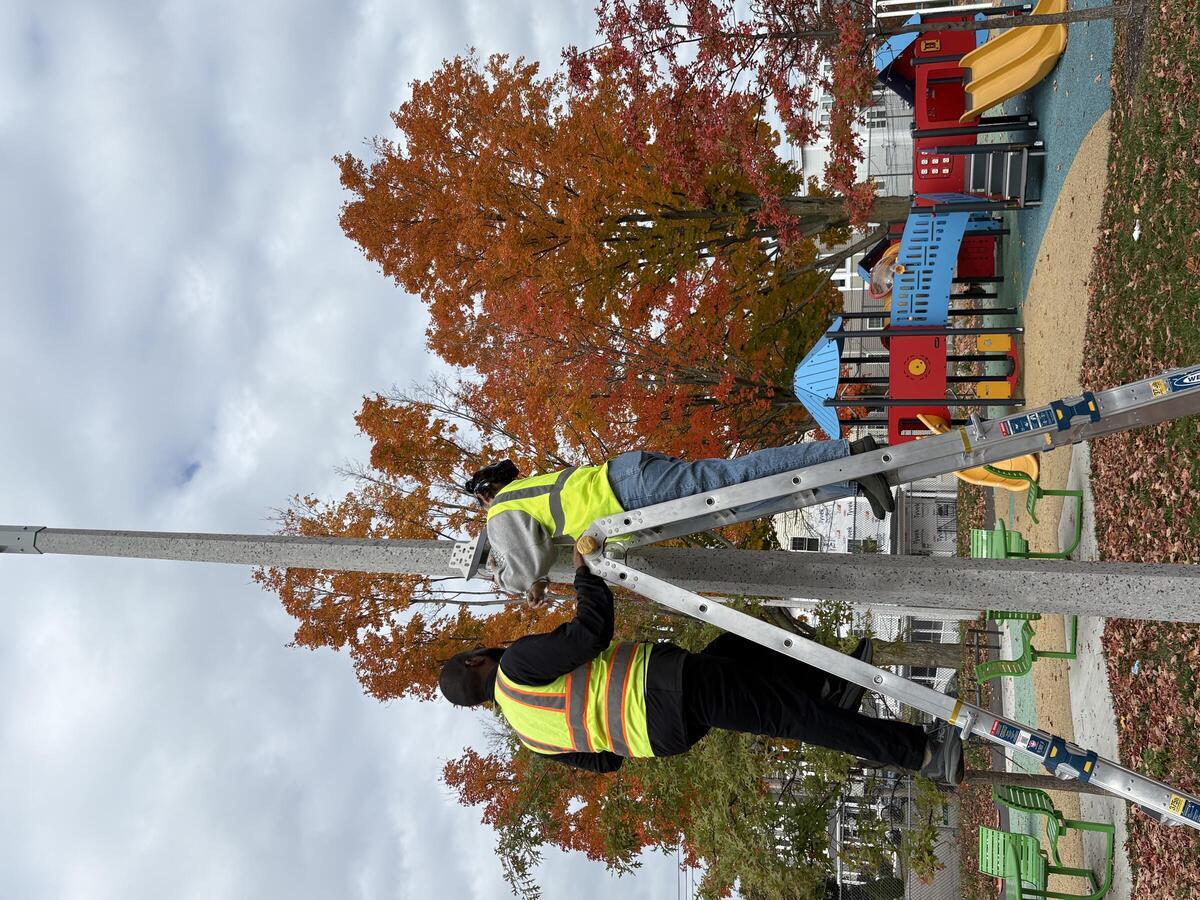
After 4 years of collective planning, collaboration, and deployment, the installation of Boston’s first environmental sensor network is complete. Pursued through the Common SENSES action-research project, the network aims to improve safety, health, and environmental conditions along Blue Hill Avenue. Rooted in community participation and ownership, Common SENSES demonstrates how our neighbors' experiences, cutting-edge technology, and the intentional use of data could help develop solutions to solve local challenges.
“In our city, the most impactful solutions are those that are community-led,” said Santi Garces, Chief Innovation Officer. “Thank you to our neighbors and City leaders, for championing how community stories and environmental data can inspire participation and meaningful change. The innovation, dedication, and service behind Common SENSES will continue to better the lives of those who call Boston home.”
- Last updated:


THE COMMON SENSES RESEARCH-ACTION PROJECT
Spread across Roxbury and Dorchester, the network includes 24 air quality sensors and 51 heat and noise sensors. The design of the network also includes a community map, outlining hundreds of reported concerns ranging from air pollution, heat, flooding, noise, and construction. By measuring extreme heat, noise, and air quality, project partners will be able to analyze the impact of environmental hazards and support environmental justice action in their neighborhoods.
“For decades, our community was ignored,” said Nicole N. Flynt, a community organizer for Project R.I.G.H.T INC. “Now we have the data, numbers do not lie. Stories plus data equal the truth. Now we have the back up we needed to prove what we are living, working and raising our families in. This is the beginning of a collaboration to develop needed change.”
The collaborators of Common SENSES include the Dudley Street Neighborhood (DSNI), Project R.I.G.H.T. Inc, the Boston Area Research Initiative (BARI) and affiliated researchers from Northeastern University, and the City of Boston’s Office of Emerging Technology. More than 300 Boston residents contributed to the project, over 17 community events and 7 workshops.
Funded by the National Science Foundation’s Smart and Connected Communities program, this initiative supports the development of novel intelligent technologies that address major community challenges in the United States.
What does the Common SENSES Project aim to do?
- Integrate community needs and perspectives into novel and new technology, fostering an impact Bostonians can feel.
- Make data on environmental hazards accessible, empowering community members, researchers, and City leaders to identify and pursue effective solutions.
- Evaluate the impact of green infrastructure, such as trees, parks, and rain gardens.
- Develop cutting-edge practices and tools for anticipatory modeling, capable of exploring environmental patterns block-by-block.
Project Development
The Common SENSES project consists of three phases, now in it's final phase:
- More than 300 community members attended workshops to share environmental hazards they have experienced and community areas they enjoy. Project collaborators reviewed community stories and input, identifying themes and priorities.
- Through 17 events and 7 co-design workshops, a plan and map of sensors was created. 24 air-quality sensors and 51 heat and noise sensors were installed in the neighborhoods along Blue Hill Avenue, with open data coming online in real time.
- Sensor installation is completed, making widespread open data available. Together, project partners and community members will analyze collected data: with findings capable of informing policies, advocacy, and projects that mitigate or prevent environmental hazards.
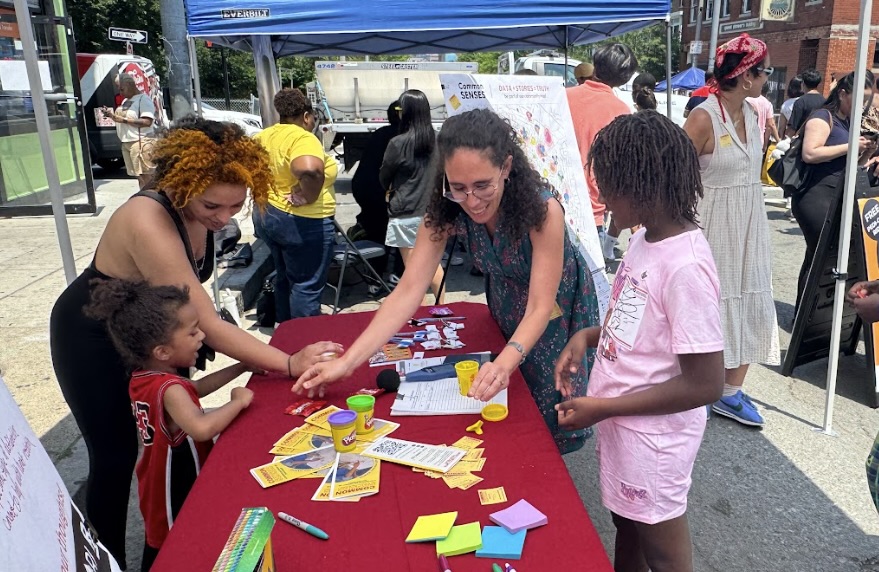
"The process of Common SENSES proves that the creation of a large-scale network of environmental sensors guided by community memories and stories is possible,” said Professor Danai Toursoglou Papalexandridou, Northeastern University. “When community members, community organizations, researchers and City actors maintain spaces of dialogue. After this experience, I cannot imagine any other way of creating a network of sensors other than letting the people who walk the streets lead the process. I am excited for all the solutions that will be led by the community and supported by real-time data moving forward."
What is the impact?
The completion of the first two Common SENSES phases opens new opportunities for Boston. Through new open data and community organizing processes, we can develop, test, and analyze locally-oriented solutions for environmental hazards. The sensor network enables residents, visitors, researchers, and City leaders to understand trends street-by-street and measure the impact of new interventions.
“The Office of Emerging Technology is proud to support the development of new technology, changing the future of how we support residents and tackle systemic problems,” said Michael Evans, Director of Boston’s Office of Emerging Technology. “The sensor network doesn’t just show how we combat climate change, but also what solutions innovation can make possible in municipal governance.”
What opportunities does the completed network make possible?
- Connecting local advocates and organizers to accurate and continuous data about their neighborhoods.
- Providing students new resources to explore their neighborhoods and learn about climate change.
- Enabling community health organizations to make informed changes for better air quality.
- Measuring the impact of building construction and green infrastructure on urban environments, supporting sustainable planning and construction.
- Over time, building historical data on how environmental hazards change.
“Common SENSES will help the City better track environmental hazards in some of Boston’s neighborhoods hit hardest by pollution, extreme heat, and more,” said Brian Swett, Chief Climate Officer. “We cannot mitigate what we do not measure, and this data will be critical in improving health outcomes, climate resilience, and quality of life all along Blue Hill Avenue.”
Common SENSES has been cited in local research, including urban heat islands, local solutions for climate resilience, and how digital twins could inform green infrastructure planning. Related research has been published by MIT Press and The Conversation, much of it written by grant-awardee Dr. Daniel O’Brien of Northeastern University.
"Common SENSES is an exciting opportunity to put cutting-edge science in the hands of the Blue Hill Ave. communities,” said Dr. O’Brien. “The sensors, the data they generate, and the block-to-block disparities in heat, air pollution, and noise that they reveal are typically only accessible to researchers and tech companies. But the community knows best how these tools can be used to benefit themselves and their neighbors."
Learn more https://www.commonsensesproject.org/. To contact the Common SENSES collaborators, email info@commonsensesproject.org.
What's Next for the Office of Emerging Technology?
The City of Boston continues to pursue a variety of innovative projects, including:
- Curb Lab: leveraging artificial intelligence, machine learning, and modern data tools to manage Boston’s parking regulations and curbs.
- Critical Mass: a partnership opportunity for climate tech startups to help advance Boston’s climate goals.
- Project Green Light: Reducing traffic congestion with artificial intelligence.
For more information on the Office of Emerging Technology, visit their homepage at www.boston.gov/oet. Interested in partnering with the Office of Emerging Technology? Email oet@boston.gov.
Please direct press inquiries to press@boston.gov. For more projects from Boston’s Innovation and Technology Cabinet, visit www.boston.gov/doit.
A huge thank you to former OET colleague Abigail Menendez, whose contributions and dedication made this project possible.
- Last updated:
