
The Sidewalk Superintendents' Club
When observing construction sites was organized urban entertainment.
There’s nothing so fascinating to a passing pedestrian like a hole in the ground, flashy construction equipment, and workers who know what they’re doing. In 1938, in Manhattan, John D. Rockefeller Jr. channeled New Yorkers' natural curiosity for construction sites to build anticipation for his spectacular new Rockefeller Center complex. He directed an enclosed viewing platform be built for people to watch the structure rise up from the groundbreaking to the ribbon cutting. With that, the first Sidewalk Superintendents’ Club was born.
The “curb kibitzers,” as the press called the members, were handed membership buttons and cards. In just the first month, 35,000 people requested membership cards. With a heavy layer of wry humor, Rockefeller installed a suggestion box for member feedback on both construction technique and clubhouse accommodations. The majority of sidewalk superintendents were male, white-collar workers, detached from day jobs that had them working with their hands. Fittingly, the club’s motto, in Dutch, translated to “The Best Pilots Stand on the Shore.”
Inspired by New York City's club, branch chapters popped up across the country to watch their local landmark excavations. In Jersey City, the sole chapter headed by a woman—a nurse—observed the building of a new medical center; the Hollywood chapter tuned into movie sets rising up and breaking down; in Fort Worth, members watched Main Street’s paving job and the federal government's building of public housing.
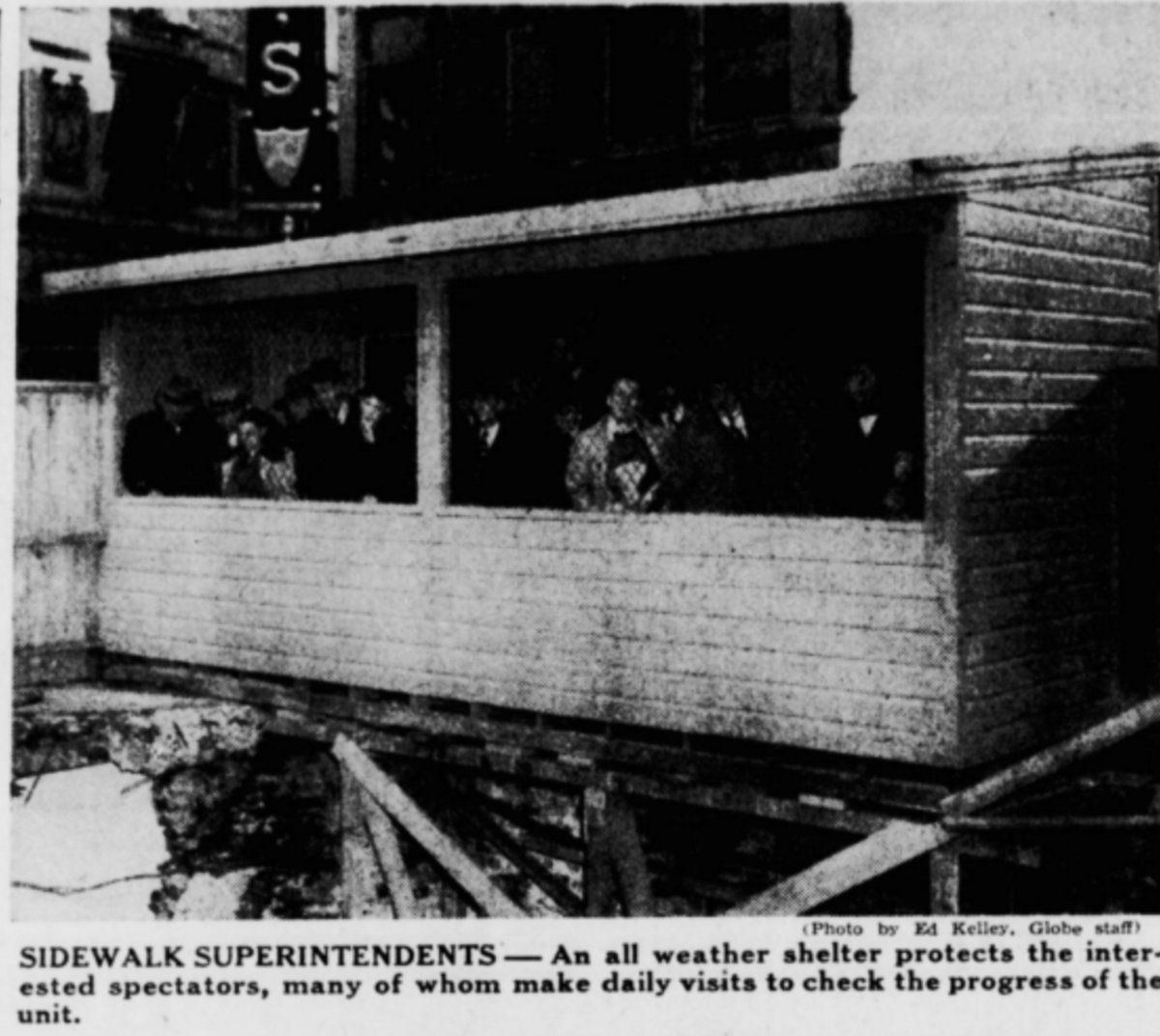
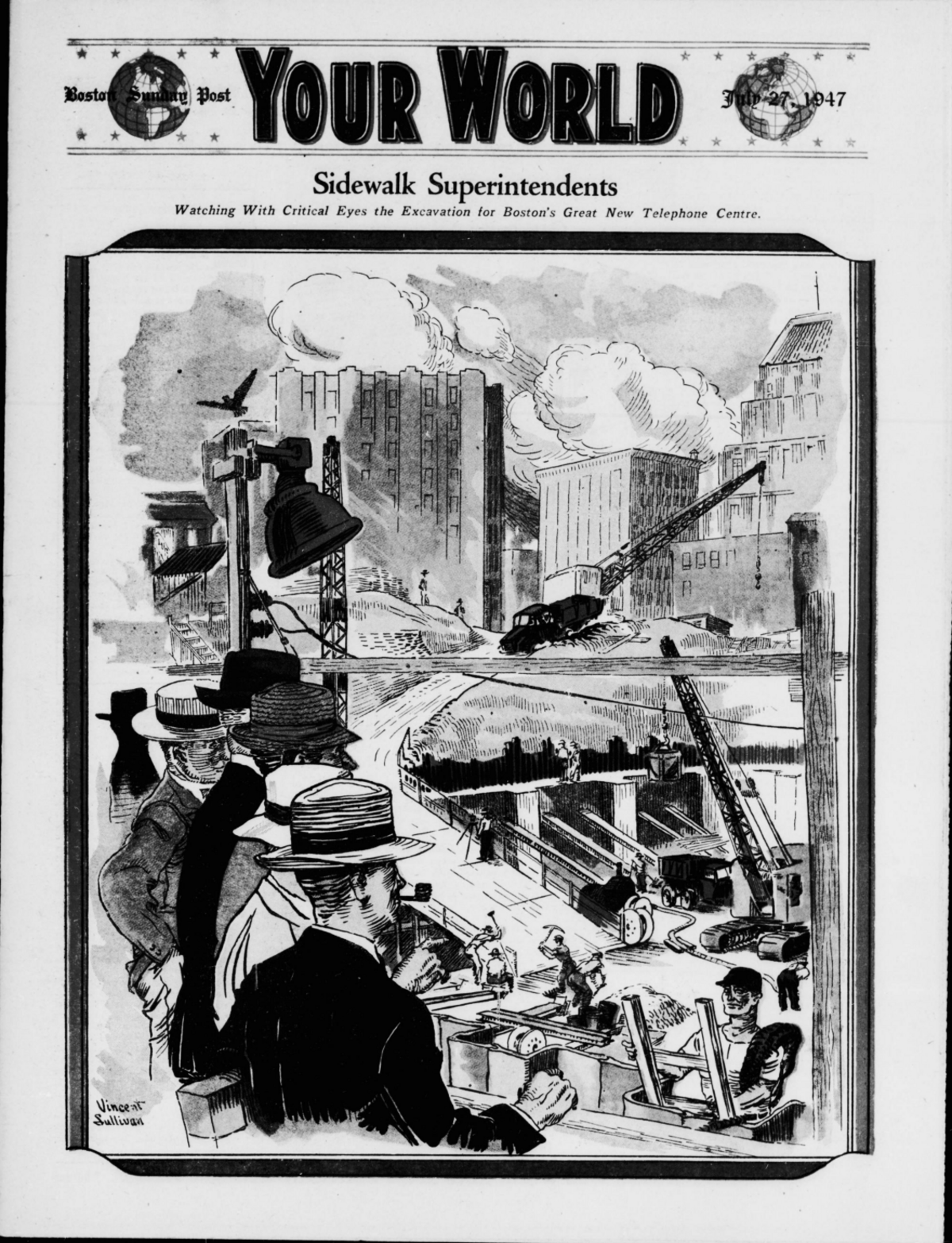
The craze caught on in Boston for the construction of the New England Mutual Life Insurance Building on Boylston Street, the New England Telegraph and Telephone Company Building in Post Office Square, the Jordan Marsh department store in Downtown Crossing, and the Prudential Center in Back Bay. Club members "on duty" at the excavation for the New England Mutual Life Insurance Company in 1939 were treated to a unique thrill when a steam shovel uncovered evidence of an ancient fishweir constructed by Native peoples to trap fish around 2,500 B.C.E. Most days as a club member were less thrilling, spent watching concrete pours and I-beams positioned into place. But to a sidewalk superintendent, they were nearly as attention-grabbing.
Most clubs were started by real estate developers to build anticipation around a project before the grand opening. In the 1950s, the Toronto Transportation Commission expanded the breadth of the clubs to public projects. For the construction of the Toronto subway system, the Commission printed manuals to give their “thousands of Sidewalk Superintendents who are on the job every day” information on the engineering marvel taking shape in the ground before them. An informed look at the construction process could lead to a more thorough appreciation, or at least an understanding, of the transit system itself.
The trend of developers establishing on-site sidewalk superintendents' clubs seemingly died out in the mid 1950s, as observation platforms shifted back to small cut-outs in fencing geared toward inspectors' views. And yet, in digital media comment sections and social media posts, the interest in discussing, critiquing, and learning about construction in the public realm lives on.
Sources:
Timothy Hyde, "On Seeing the Construction Site Disappear," Thresholds (2024) (52): 136-145.
Chris Bateman, "A Proud History of Sidewalk Superintendents in Toronto," Spacing, May 27, 2025, accessed April 15, 2026, https://spacing.ca/toronto/2015/05/27/proud-history-sidewalk-superinten….
Boston Globe, Boston Post, New York Times. Accessed via Proquest.
