
Layers of Dorchester: Unearthing 190 Bowdoin Street
In May, the City of Boston Archaeology team excavated at 190 Bowdoin Street in Dorchester in collaboration with property owner VietAID (Vietnamese American Initiative for Development).
VietAID is planning a new building called Hollins Park that will transform the property into a new 100% affordable family housing development by removing a long-vacant house that dates to c. 1810. As part of the effort to mitigate the loss of this historic building and landscape, the City Archaeology Program planned a survey excavation of the site, supported by historical research that shed light on the long history of the lot and its occupants.
190 Bowdoin Street in history
Long before Europeans arrived, Dorchester was part of the traditional homelands of the Massachusett people. The Neponset Band’s territory encompassed the Neponset River watershed, with a principal village near today’s Lower Mills.
Although the English Crown knew Native peoples inhabited Massachusetts, colonial law largely disregarded Indigenous land ownership and sovereignty. The Crown claimed authority to grant their lands to English settlers, who later cited John Smith’s 1614 exploration and mapping as supporting England’s claim.
After the Dorchester Company’s failed Cape Ann settlement, King Charles I chartered the Massachusetts Bay Company in 1629. In 1630, about 140 settlers sailed aboard the Mary and John, landing near present-day Columbia Point and establishing a settlement near today’s Edward Everett Square.
Land was allotted according to settlers’ financial contributions, creating English legal title without regard to Indigenous relationships to the land. The earliest documented owner of the land including 190 Bowdoin Street is John Wiswall in 1742, though earlier ownership remains to be traced.
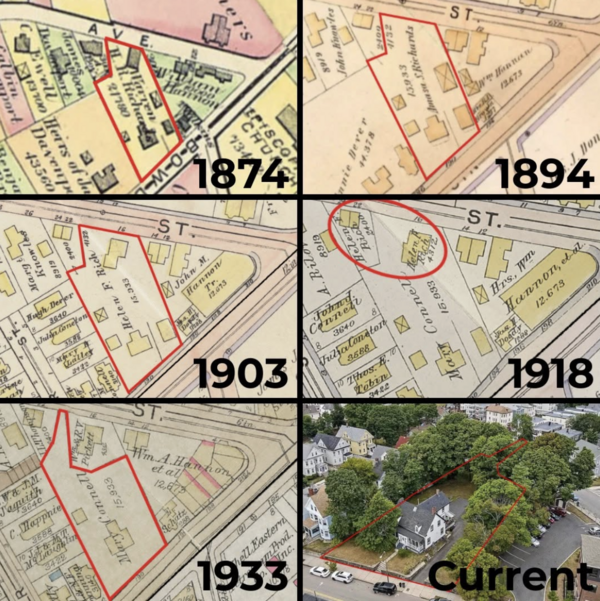
Records show a house here by 1759, although the present house dates to about 1810. That year, teacher Stephen Hale purchased the property for the Dorchester Juvenile Academy, a boys’ school operating from about 1805 to 1817. Hale replaced an existing “small tenement” schoolhouse with a “new, commodious, & pleasantly situated” building. Financial difficulties closed the school in 1817, and the property was auctioned to Stephen Wentworth.
In 1831, the property became home to cabinetmaker, farmer, developer, and mechanic Warren W. H. Richards. He and his wife, Nancy Maria Howe, had at least two children, Warren Washington and Amasa Stetson. A seven-year-old Leonard appears with the family in the 1855 Census, but his relationship is unknown.
By 1874, maps show the house, a shop, two stables, and a greenhouse. A double house in Richards’s tax records was likely today’s 22–24 Olney Street.
Warren Washington died in Virginia during the Civil War in 1862. Amasa became a carpenter and later returned to Dorchester. After his parents died, he remained at 190 Bowdoin and operated his business from the shop at 194 Bowdoin.
The family also rented the shop to willow worker Charles A. Bauch and later a painting company. During repairs in 1916, the date 1806 was found carved into an oak support post, suggesting the workshop may have incorporated the original school building. It appears on atlases through 1918 but was gone by 1933.
By 1899, a house stood at 16 Olney Street, possibly built for Helen F. Rich, longtime housekeeper and nurse to Amasa and his mother. Amasa left her his estate in 1902. She sold the main property to the Connell family in 1908 but retained 16 and 22–24 Olney Street.
The Connell, Quilty, DiBenedetto, and Hollins families subsequently owned the property before VietAID acquired it in 2024. After the Vietnam War, thousands of Vietnamese refugees settled in Dorchester, many in nearby Fields Corner. Founded by refugees and immigrants in 1994, VietAID builds housing, provides human services, and supportive economic opportunity programs for the growing Vietnamese-American community.
Uncovered history at 190 Bowdoin Street
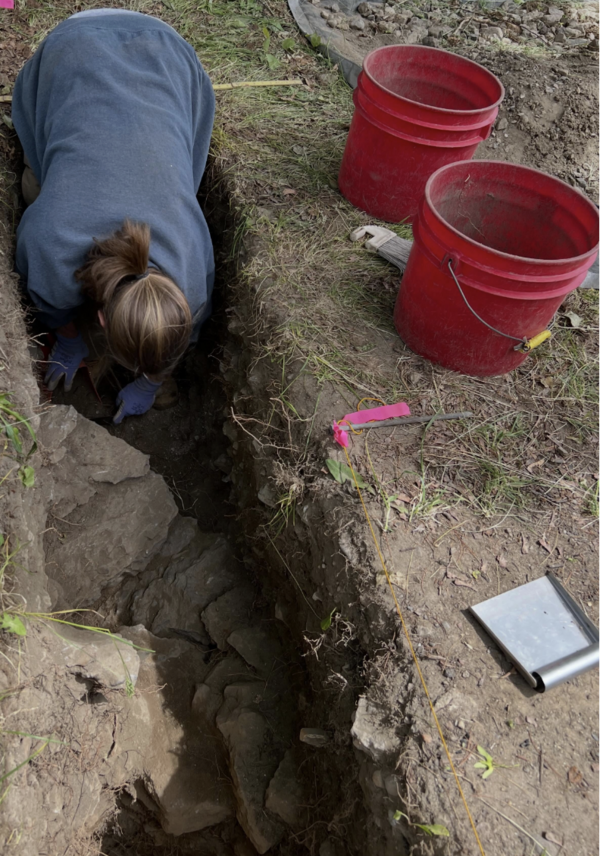
The City of Boston Archaeology Program excavated four strategically placed trenches: three to explore the now lost workshop, greenhouse, and shed marked on historic maps, and a fourth behind the c. 1831-1874 house ell. The former three were placed on an angle to determine the interior and exterior features the team was looking for, while the latter was placed parallel to the back of the ell addition.
Though the number of artifacts recovered was low and mostly from the late 19th and early 20th centuries, the team was able to locate the stone foundation wall of the workshop and structural elements of the greenhouse and shed.
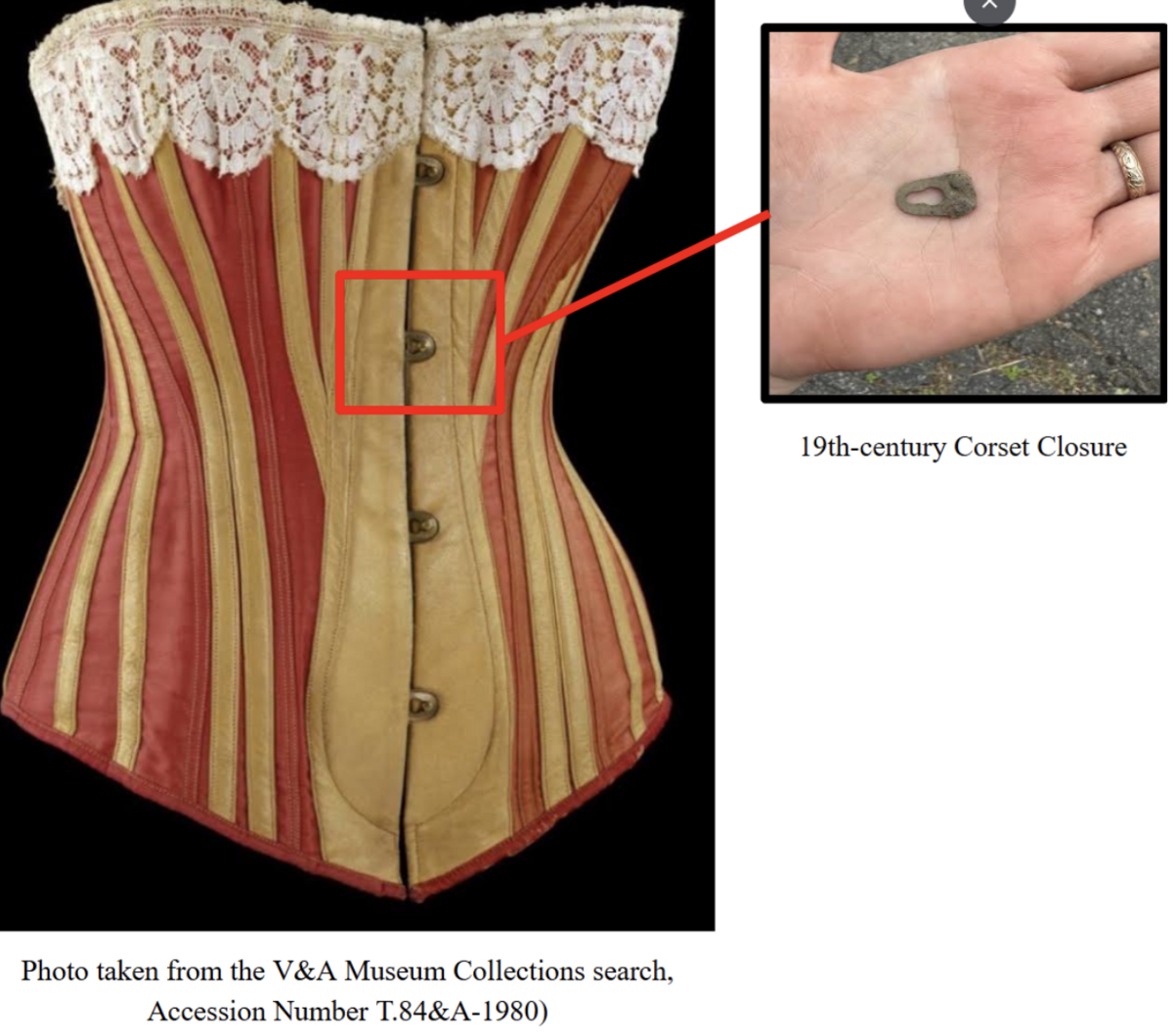
Among some of the more exciting objects the team recovered were a 19th-century copper alloy corset closure for a front-closing women's corset (see photograph), a small blade for a hacksaw (possibly for furniture making), a stamped decorative copper button, a metal drawer pull, several glass and clay marbles, and several porcelain buttons.
City of Boston archaeologists may return to investigate the site further before deconstruction of the 1810 house begins.
This article was prepared by Lauryn Sharp, Project Archaeologist.
- Last updated:
-

- Last updated:
-
