
What's in a Dig?
Most archaeology happens behind the scenes. Keep reading to learn what an archaeological excavation in Boston entails.
Pre-dig
Determine archaeological sensitivity
The archaeological sensitivity of an area is its potential to contain archaeological resources within its soils. This is determined by considering a few things like known sites in the vicinity, the history of the land use and development, historical or current natural features in the area such as ponds or streams, and the topography of the land.
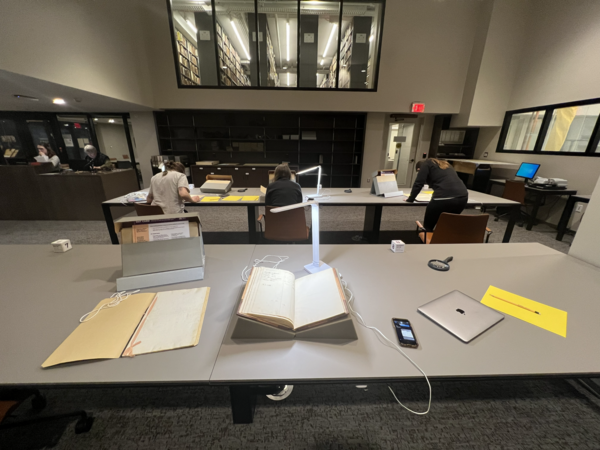
- Any project that receives any kind of state or federal permitting, licensing, or funding is subject to review.
If an area is determined to be archaeologically sensitive by our staff, we would then analyze any schematics or plans provided to determine what impact a project is likely to have upon the potential archaeological resources in the ground. If there is no way to avoid a sensitive area, the project may warrant an excavation to recover important historical data that would otherwise be destroyed. It is best to submit development plans early to avoid delays to your desired timeline.
hire an archaeological contractor
Once it has been determined that an area is archaeologically sensitive and that a dig is the best way forward, the proponent must hire an archaeological contractor. An archaeological contractor is an archaeologist who meets the standards of the U.S. Secretary of the Interior. The City of Boston Archaeology Program staff can help you find a qualified cultural resource management (CRM) firm to conduct a dig.
If necessary, the contractor will obtain an archaeological permit from the State Archaeologist, research the site, conduct the dig, process any artifacts recovered, and produce a site report. Depending on the size and complexity of the project, and the state of the archaeological resource, this process can take anywhere from a couple of weeks to several months.
Excavation
Archaeological survey happens in phases. These phases include: Reconnaissance, Intensive (locational), Site Examination, and Data Recovery.
Excavation phases
Phase IA: Also known as Reconaissance, this includes researching the project area to determine its likelihood to contain archaeological resources. This is usually followed up with a site walkover.
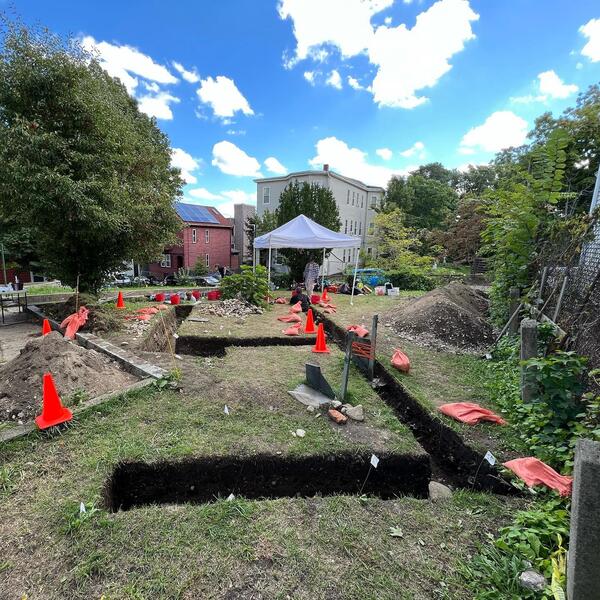
Phase IB: Once sensitivity of the project area is determined, the contracted Principal Investigator (PI) and Project Archaeologist (PA) begin an Intensive (locational) survey. They decide where to place exploratory 50 cm x 50 cm square hand-dug shovel test pits (STPs) to try and locate as many archaeological deposits within the project area as possible. If enough archaeological deposits survive in good condition, the dig will progress to Phase II. If no site is found or if it has been too disturbed, no further archaeological testing will be recommended.
Phase II: If Phase I testing results in the location of an archaeological site within the project area, the excavation progresses to a Site Examination. In addition to STPs, this phase includes the excavation of 1 m x 1 m square excavation units (EUs). By opening up a larger window into the soil, the archaeologists will work to determine the nature and size of the archaeological site. Determination of eligibility for the National Register of Historic Places happens at this stage. If the site is eligible for inclusion and mitigation by avoidance (redesign) is not possible, the dig progresses to Phase III.
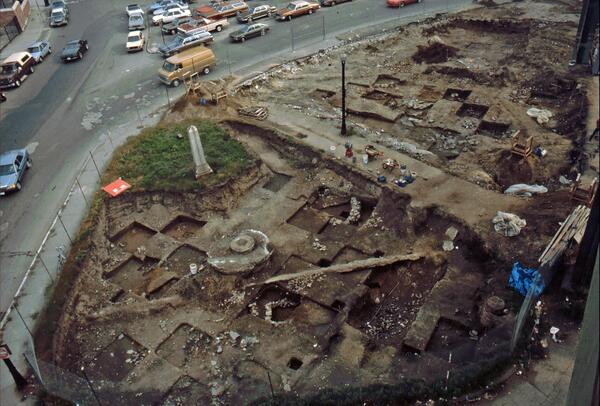
Phase III: The final phase of archaeological excavation is called a data recovery. If a significant archaeological site cannot be avoided though project redesign, archaeologists will excavate as much of the site as is possible. These excavations can be large and often involve collaboration with the state and/or federal agencies. The goal of data recovery is to systematically remove the site from the project area completely to gather as much information about it as they can.
Archaeological survey is only considered complete after the Primary Investigator for the survey has submitted a completion memo to the City of Boston Archaeology Program and the project proponent receives written permission from the Archaeology Program to proceed with the project
To read about archaeological excavation phases in more detail, click here.
Post-dig
Artifact processing
Washing: Archaeological artifacts are collected in plastic bags in the field, and objects that are found together stay together to preserve their context, which makes it possible for archaeologists to interpret the site. They stay together throughout the entire process.
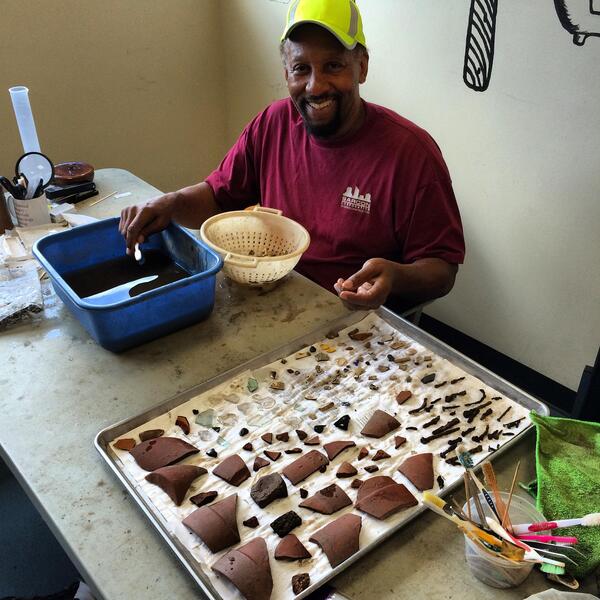
First, artifacts are brought back to the lab to be washed. Using plain water and sometimes a toothbrush or other tools, artifacts are gently cleaned of soil and debris and set to dry completely on wire racks.
Cataloging: Once the artifacts are completely dry, an archaeologist identifies and counts them for entry into an artifact catalog. The catalog includes an object's provenience, information collected in the field that tells us where on the site it came from, including how far down in the ground. This data allows us to interpret the kinds of activities that took place at the site in the past and better understand how people experienced the world hundreds or even thousands of years ago.
documentation
Report Production: The contracted archaeologist produces a site report to be submitted to the project proponent, the Massachusetts Historical Commission (MHC), and the City of Boston Archaeology Program. The site report explains the history of the project area, the details of the excavation, the contents of the site, and the interpretation of the PI or PA. It also includes their recommendations for site management and next steps.
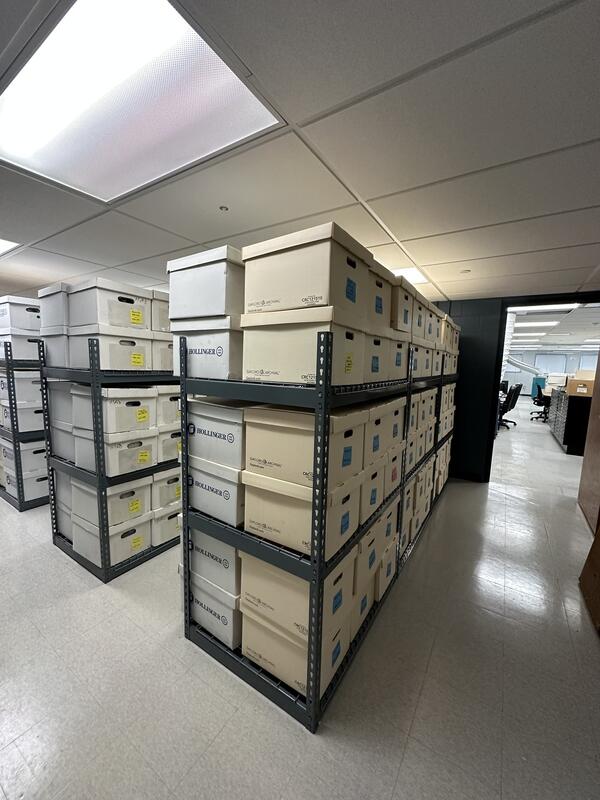
Curation: After the artifacts have been cataloged and analyzed, they are rehoused by context in archival quality plastic zip-top bags, labeled with their provenience information, and stored in archival quality banker's boxes. Depending on your agreement with the CRM firm you contracted and the circumstances of your particular case, the artifact boxes may be curated at the CRM firm's facility, at the state repository, or at the City repository. Any artifacts excavated under a Massachusetts state archaeological permit belong to the Commonwealth.
-
Still have questions? Contact:
Archaeology
-
 201 Rivermoor Street
West Roxbury, MA 02132


-
Still have questions? Contact:
Archaeology
-
201 Rivermoor Street
West Roxbury, MA 02132
