
Pathway To Bilingual Schools
The Office of Early Childhood aims to build a sustainable pathway from monolingual non-English and bilingual child care settings to bilingual Boston Public Schools.
We will train early educators and support families in bilingual development in young children so that children enter school with a solid family/community language and the English skills they need for kindergarten.
-
Still have questions? Contact:
Early Childhood
-
 1 City Hall Square
Boston, MA 02201


What does it mean for early education and care?
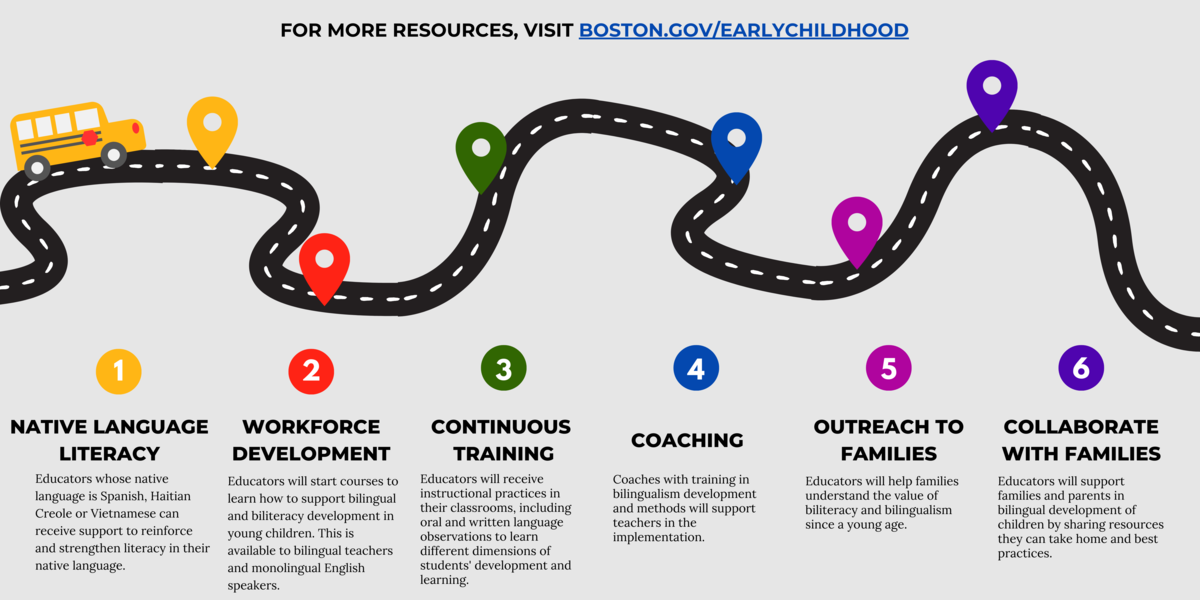
1. NATIVE LANGUAGE LITERACY
Educators whose native language is Spanish, Haitian Creole or Vietnamese can receive support to reinforce and strengthen literacy in their native language.
2. WORKFORCE DEVELOPMENT
Educators will start courses to learn how to support bilingual and biliteracy development in young children. This is available to bilingual teachers and monolingual English speakers.
3. CONTINUOUS TRAINING
Educators will receive instructional practices in their classrooms, including oral and written language observations to learn different dimensions of students' development and learning.
4. COACHING
Coaches with training in bilingualism development and methods will support teachers in the implementation.
5. Outreach to FAMILIES
Educators will help families understand the value of biliteracy and bilingualism since a young age.
6. COLLABORATE WITH FAMILIES
Educators will support families and parents in bilingual development of children by sharing resources they can take home and best practices.
FOR MORE RESOURCES, VISIT BOSTON.GOV/EARLYCHILDHOOD
What does it mean for young children?
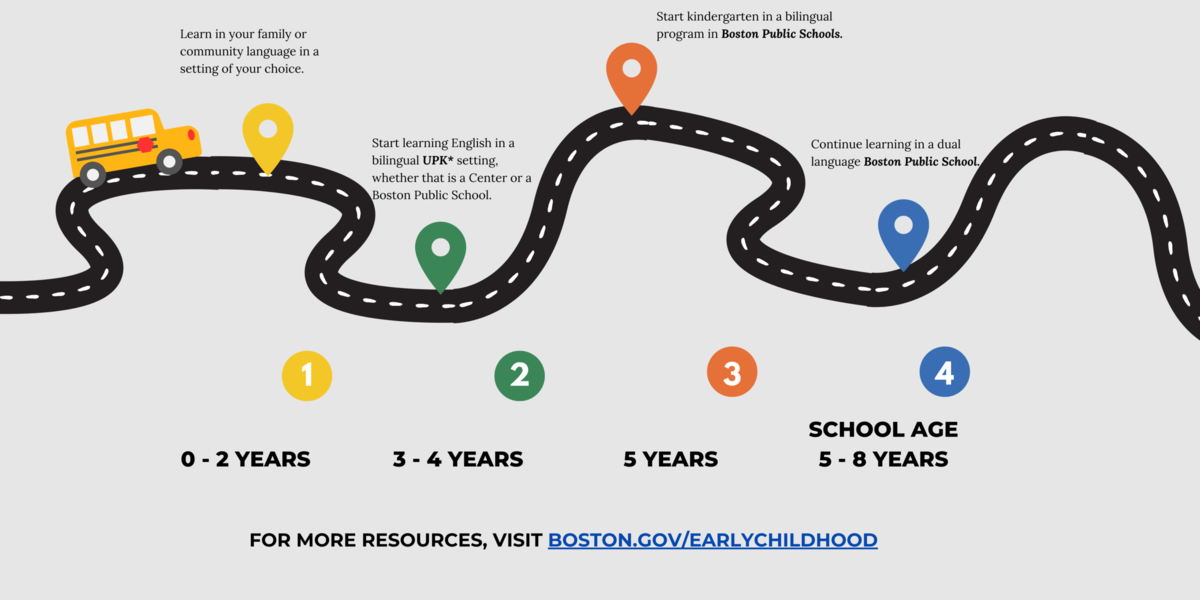
1. Children 0-2 Years old
Learn in your family or community language in a setting of your choice.
2. Children 3-4 Years old
Start learning English in a bilingual UPK* setting, whether that is a Center or a Boston Public School.
3. Children 5 Years old
Start kindergarten in a bilingual program in Boston Public Schools.
4. Children 5-8 Years Old (School Age)
Continue learning in a bilingual Boston Public School.
-
Still have questions? Contact:
Early Childhood
-
1 City Hall Square
Boston, MA 02201
