
114 New Football Fields... of Tree Canopy Gain!
Assessment shows Boston’s tree coverage grew significantly between 2019-2024.
Those of us in the Urban Forestry Division know the populace has been clamoring for our newest drop–our second collab with the University of Vermont Spatial Analysis Lab. Ever since its premiere in 2020, there has been nonstop speculation on whether the sequel would be as monumental. Finally the wait is over, and it was one well worth it. Residents of Boston, denizens of Massachusetts, and citizens of the World, it is our pleasure to announce: The 2019-2024 Boston Canopy Change Assessment.
For those who might not have been keeping up with this urgent matter, The Urban Forestry Division is committed to collecting detailed data about the tree canopy across the city every five years. The first analysis, which compared data from 2014 and 2019, helped to shape the goals and strategies of the 2022 Urban Forest Plan (UFP). This latest assessment looks at canopy change between 2019 and 2024 and will continue to guide the work of the Division. The assessment was commissioned by the Urban Forestry Division and conducted by the University of Vermont Spatial Analysis Lab. The report provides detailed data of successes in our efforts to expand and maintain Boston’s tree canopy, in addition to highlighting challenges where new strategies or more resources may be needed.
“This analysis gives us the clearest picture yet of how Boston’s urban forest is changing and where our efforts are making the biggest difference,” said Cathy Baker-Eclipse, Interim Commissioner of Boston Parks and Recreation. “Since 2019, our Urban Forestry Division has expanded, increased tree planting in priority neighborhoods, and expanded proactive canopy management. Canopy gains on public land across the city reflect that work and reinforce the importance of data-driven stewardship.”
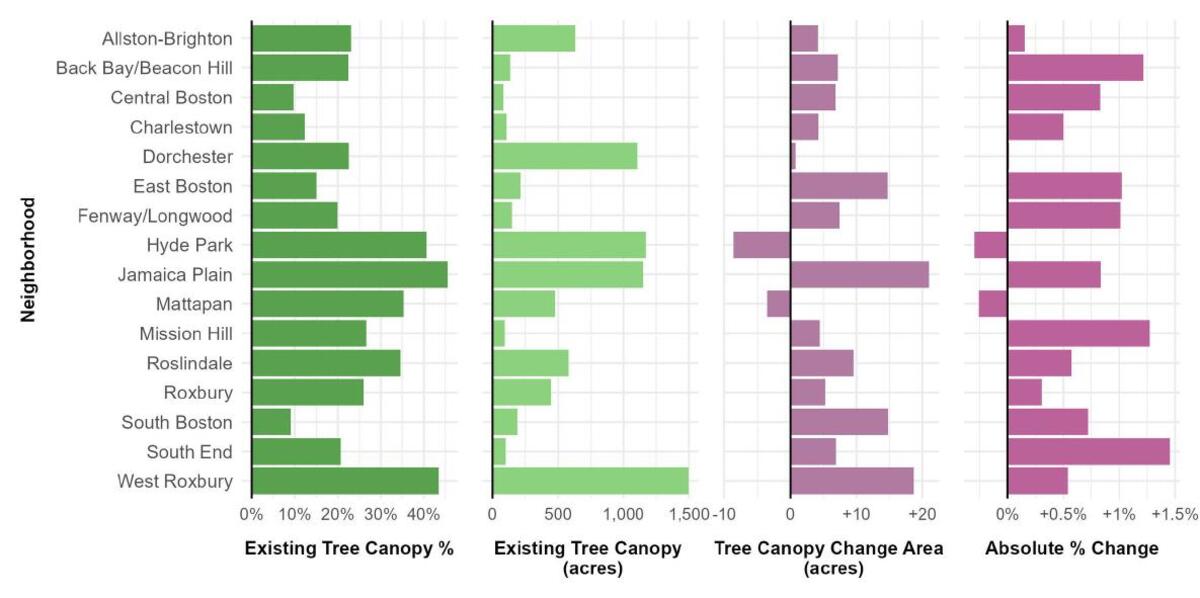
We are most proud of the result that Boston’s tree canopy tallied a net increase from 2019 to 2024, with investments in trees on City property contributing significantly to canopy gain over the assessment period. Net canopy coverage increased by 0.5%, or 151 acres–the equivalent of 114 football fields!
Some key insights:
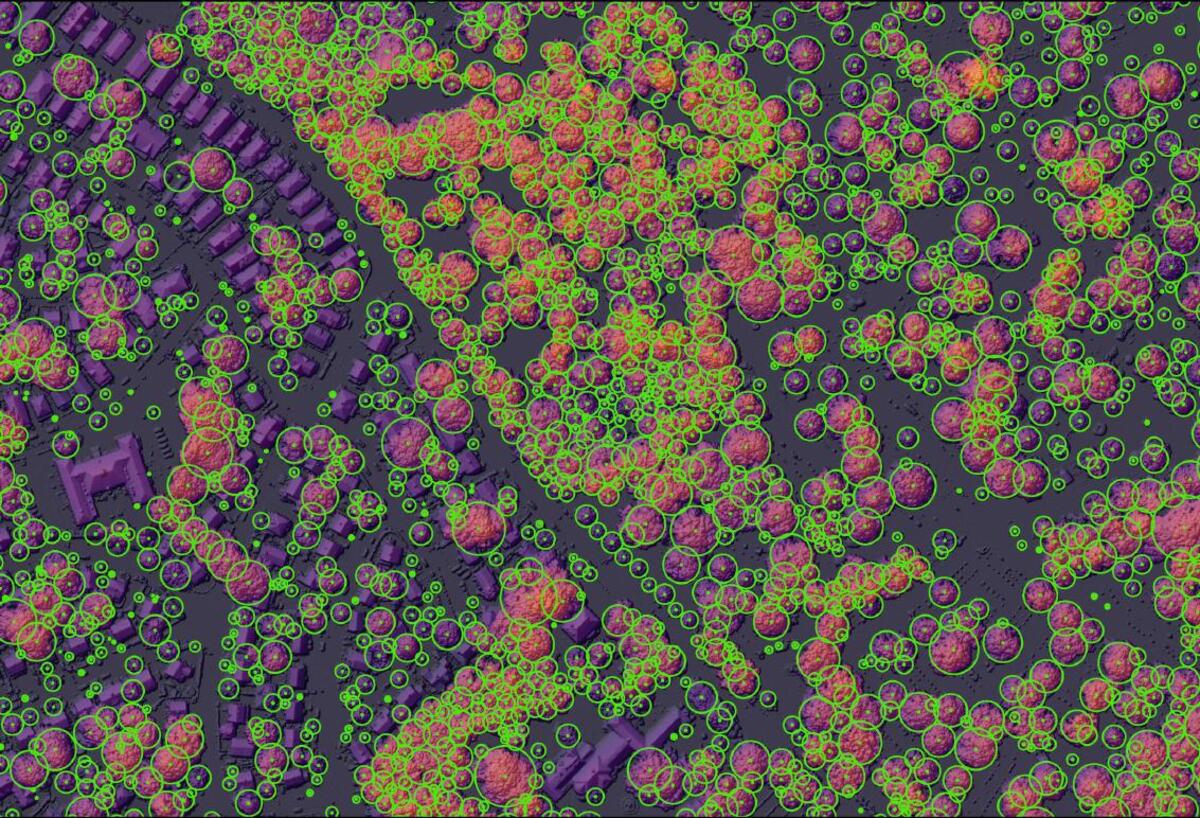
- There are over 496,600 individual trees across the City of Boston.
- Priority Zones identified in the Urban Forest Plan, adopted only in 2022, saw a net increase of 0.4% canopy cover.
- These zones were determined by factors such as being under-canopied and historically marginalized.
- 50% of all canopy cover in Boston comes from small forest patches.
- There is a large distribution of tree heights across the City.
- A diversity of tree height and age supports a more resilient canopy over time.
- Gains of tree canopy on public land more than offset losses on private property.
Neighborhoods with the largest net gain: East Boston, Jamaica Plain, South Boston, West Roxbury
Neighborhoods that showed a net loss: Hyde Park and Mattapan
Of all tree canopy across the City of Boston, 35% of it exists on residential land, which saw a loss of 116 acres of tree canopy. This loss highlights the need to engage with homeowners to maintain the City’s tree canopy. Even with the net loss, there was still growth on some private property. The Boston Tree Alliance has also been a critical component working with residents to increase tree canopy on private property.
The silver lining with this data is that gains of tree canopy on public land more than offset losses on private property. For areas that saw net increase in tree canopy, the standouts are Open Space and Right of Way (ROW), which saw increases of over 175 acres combined. These insights will be key in guiding the Urban Forestry Division’s execution of the Urban Forest Plan, which provides a 20-year framework for improving our tree canopy. While the canopy change assessment shows that there has been net growth, we know there is still much work to be done.
The success of the Urban Forestry Division has been bolstered by many community partners. The work of dedicated non-profits, civic associations, and community groups have all been instrumental in building our tree canopy for a greener more resilient future. An invaluable partner in our work has been Bill Masterson, Executive Director of Tree Eastie, who said, “Through this collaboration, the work of Tree Eastie has evolved to include bilingual community outreach, tree planting in private yards, fruit tree maintenance, increased tree planting in public parks, and targeted maintenance for young trees. Publishing this analysis reinforces the City's commitment to transparency and providing data-based information about the value of trees in the community.”
Interested to know more?
Visit the Canopy Change Assessment webpage to see the report and other useful information including downloadable data. The Parks Department has also created and Explorer tool to help residents digest the data and see what is happening on their own block.
- Last updated:
-


- Last updated:
-
