
Ensuring the Responsible Public Use of Generative Artificial Intelligence
When City workers have the right tools, they can deliver better services to residents. As the City of Boston evaluates how to use generative AI responsibly, it is essential to understand not only what generative AI can offer, but how we can support and prepare our workforce.
In 2023, the City of Boston was one of the first major cities in the United States to release generative AI guidelines. These guidelines were designed to empower the responsible and effective use of generative AI, including principles, sample use cases, and risks to be aware of. As this emerging technology rapidly develops, the City of Boston is continuously researching, testing, and implementing infrastructure for the responsible public use of gen AI. We've used what we've learned since the guidelines were released in 2023 to develop our City Policy on the use of Generative AI.
Generative AI refers to artificial intelligence tools that can create different types of content based on your instructions, such as Google Gemini, Claude, or ChatGPT. Modern gen AI assistants can create and edit text (such as reports or emails), analyze documents, images, and data, generate new images from descriptions, answer questions, explain complex topics, and summarize large volumes of information.
- Last updated:
-

How does the City of Boston workforce use generative AI?
In spring 2025, we surveyed employees on how they’re using generative AI tools. We asked employees how they want to use generative AI, their familiarity with the tech, and what kind of training they prefer.
More than 20% of City of Boston employees (not including Boston Public Schools, Boston Fire, Boston Police, Boston Public Health, and the Boston Public Library) answered the survey. From their responses, we learned how staff are currently using these tools, what concerns exist, and what support they need.
The goal was to understand what’s working, what’s unclear, and what kind of support our City workforce needs. This survey is part of the City’s broader strategy to integrate generative AI into public service responsibly and effectively.
Key Survey Insights
- Usage is widespread. About 6 in 10 respondents have tried generative AI in the past, with 1 in 4 using it weekly at work. Usage is highest among younger employees and those newer to their roles.
- City workers care to use gen AI responsibly. Top concerns from our colleagues include inaccuracy, data privacy, and intellectual property.
- City workers want to learn. 78% of respondents said they are interested in learning how to use generative AI for their work. Half of the respondents said they are “very interested,” signaling strong demand for training.
- Preferred uses are practical and straightforward. Employees are most interested in using AI for writing, summarizing, and data analysis.
- Confidence in generative AI varies. While interest is high, 42% of respondents reported lower confidence using new digital tools, and 25% expressed similar uncertainty using search engines.
- Live support matters. City workers are most interested in learning preferred in-person or virtual training sessions over self-paced options, and many would also value one-on-one support.
Concerns with generative AI use
City workers remain dedicated to high-quality and accurate public service, including how they use generative AI. Leading concerns included:
- Inaccuracy (68.5% of respondents)
- Security (57.6% of respondents)
- Plagiarism and intellectual property (53.8%)
- Data privacy (50.6%)
- Bias (35.8%)
- Job displacement (33.1%)
- Ill-intent / unethical purposes (30.6%)
- Other / not listed here (6.6%)
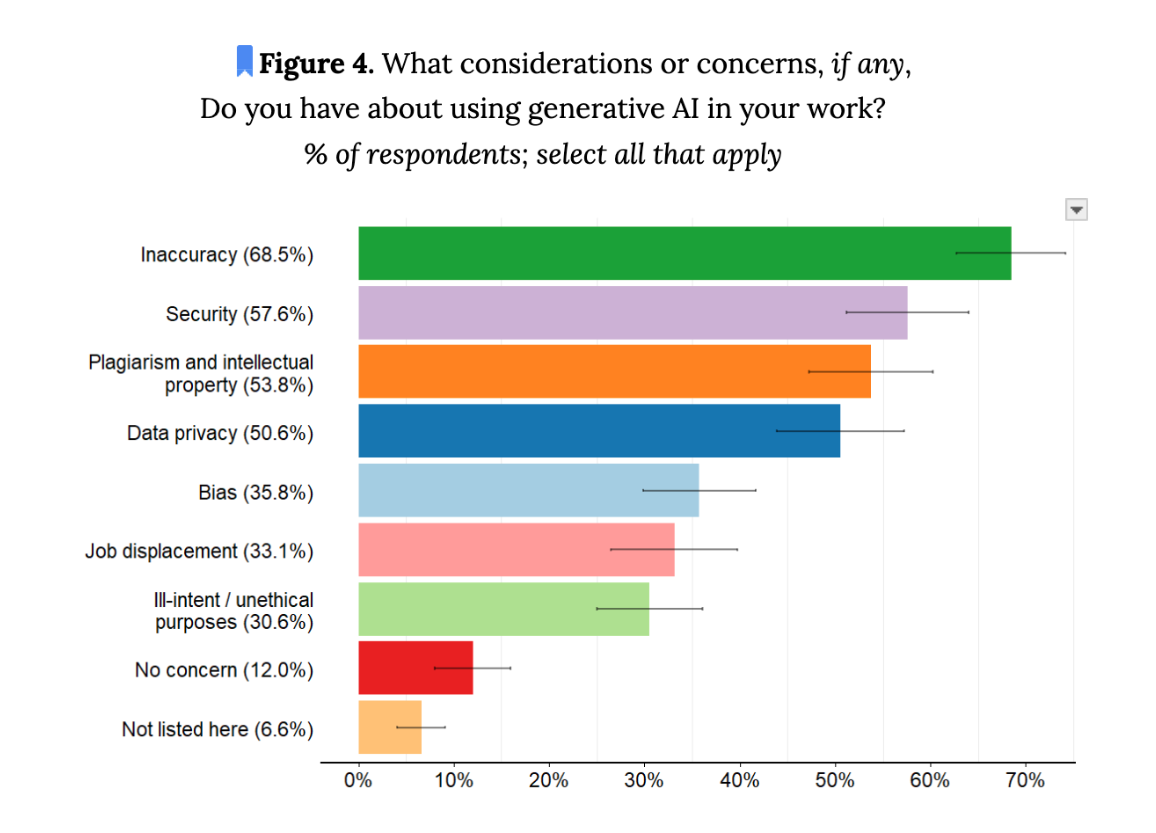
Survey respondents were invited to share additional comments at the end of the survey. 8% of additional comments expressed concern about the environmental impact of generative AI.
What opportunities can generative AI create for City workers?
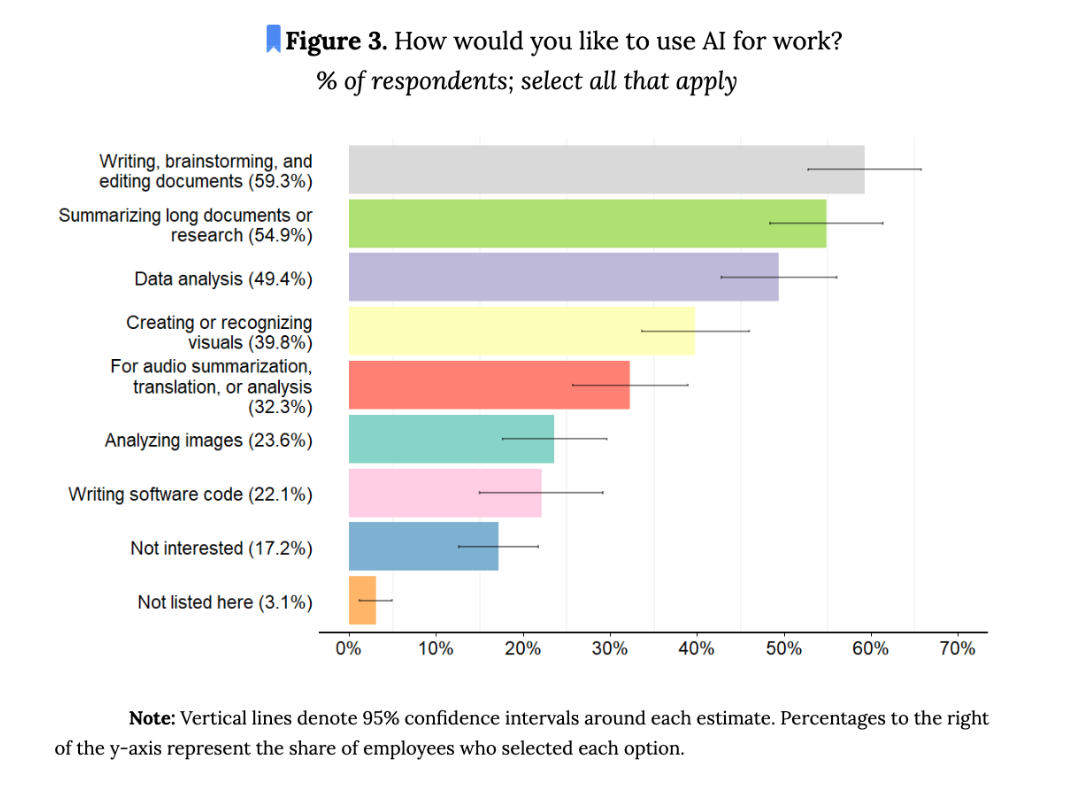
Generative AI presents new opportunities for public servants to develop greater comprehension, problem solve, and deliver excellent city services. City workers are curious to explore these tools for these purposes.
- Through data analysis, research support, or document summaries, generative AI can give public servants more context and perspective on City projects.
- The City of Boston's Generative AI Policy was developed, in part, to help employees understand where generative AI should be used and where it should be avoided.
Using generative AI to support Boston residents
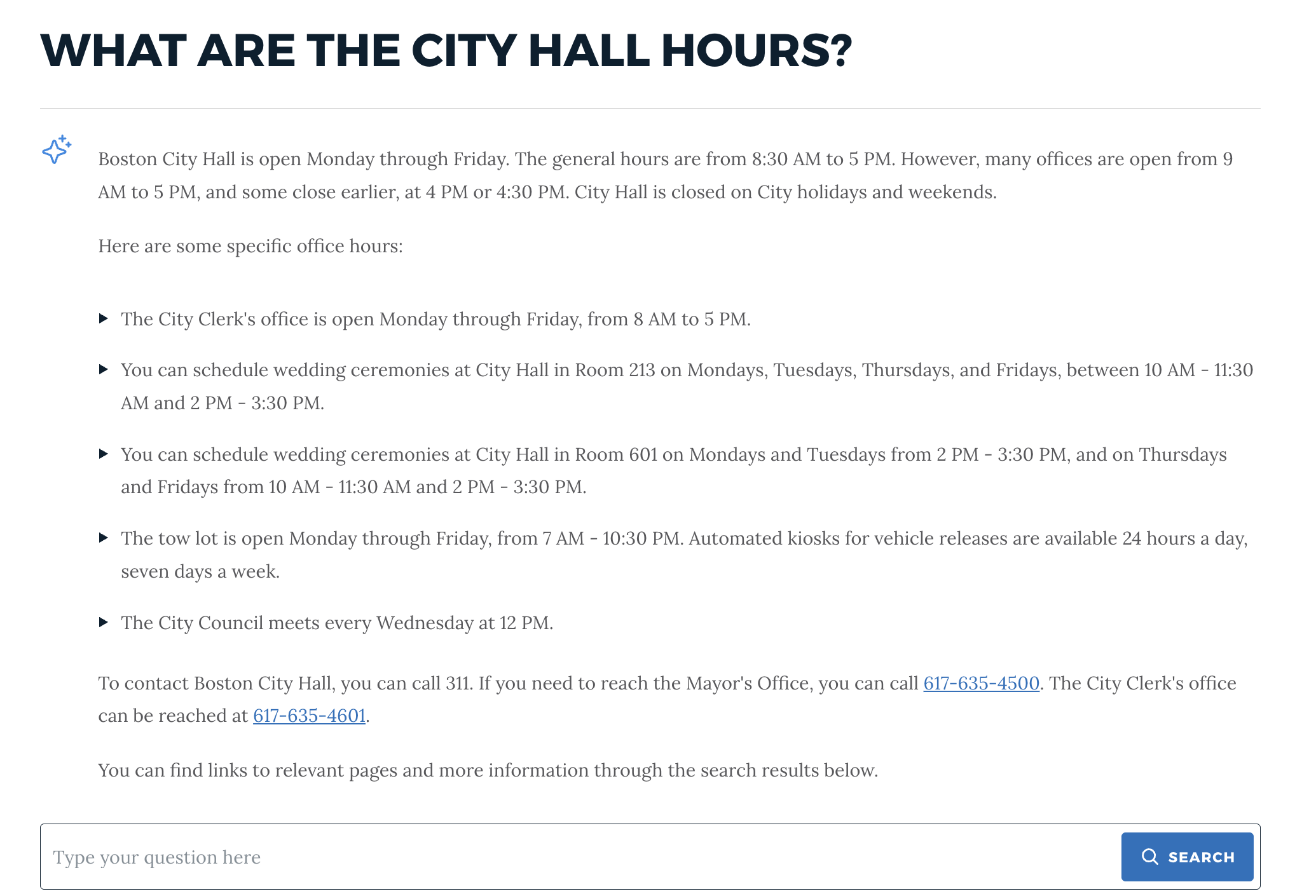
Ensuring information is accessible and easy to find is a priority for our Digital Service Team. To deliver on this priority, beta AI search is currently available on Boston.gov. This tool allows residents and users to search a question for an aggregated summary across multiple web pages.
Initial results show that AI search on Boston.gov garners more positive feedback than traditional search. As of December 2025, positive feedback for AI search (34.3%) outperforms traditional search (10.9%) by 23.4 percentage points.
This function exists on the 60 most visited pages on boston.gov, using Google Gemini to connect Bostonians to the information they need. that constituents can have better digital experiences through this tool, while reducing our potential cost of maintenance.
What's Next?
In the coming months, the City of Boston plans to release updated generative AI guidelines informed by this research. For information on the Innovation and Technology Cabinet, please visit boston.gov/doit.
Please direct press inquiries to press@boston.gov or doit@boston.gov.
- Last updated:
-
