
Haymarket Food Recovery
We helped the historic Haymarket in downtown Boston send less food to the landfill and send more fresh food to the tables of Boston residents.
By working with the Haymarket Pushcart Association, food recovery groups, partners at the State, and other departments at the City of Boston, we redesigned systems to reduce food waste and created a pipeline for recovered food to go to the Greater Boston Collaborative Food Access Hub.
Why We Did This
Haymarket is a historic, open-air public market operating two days a week throughout the year providing affordable produce to a diverse clientele of Boston residents. Haymarket is a cultural cornerstone of the city with a tradition of selling fresh, affordable produce in Boston that dates back to nearly 300 years.
The Haymarket Pushcart Association (HPA) reached out to us this year with a request for help improving their waste management and food recovery practices. Like many cities around the world, Boston sees a large amount of food go to waste—a problem that drives 8 percent of all global carbon emissions. An estimated 130,000 tons of food are wasted in Boston each year from the residential, commercial and industrial sectors and food is the greatest percentage of material by weight in Boston’s total, residential, and commercial waste streams, comprising 25%-29% of all waste that ends up in the landfill.
The HPA wanted to efficiently and effectively manage its trash system to reduce waste and recover safe, nutritious food for distribution to communities across Boston. With the City’s goals to become a zero waste city and connect food insecure residents with fresh, healthy food, this was a great opportunity for us to partner on our shared goals.
What We Did
The Mayor’s Office of New Urban Mechanics team created a suite of tools and systems to improve Haymarket’s food recovery and waste management process:
Signage: We created new color-coded signage with clear instructions on what to include in each compactor, including images and translations in the market’s top 4 languages: English, Spanish, Arabic, and Chinese.

Purchasing Guide: We worked with experienced vendors to create a purchasing guide for vendors and translated it into the market’s top 4 languages. The guide is named after Otto, the HPA's President Emeritus.
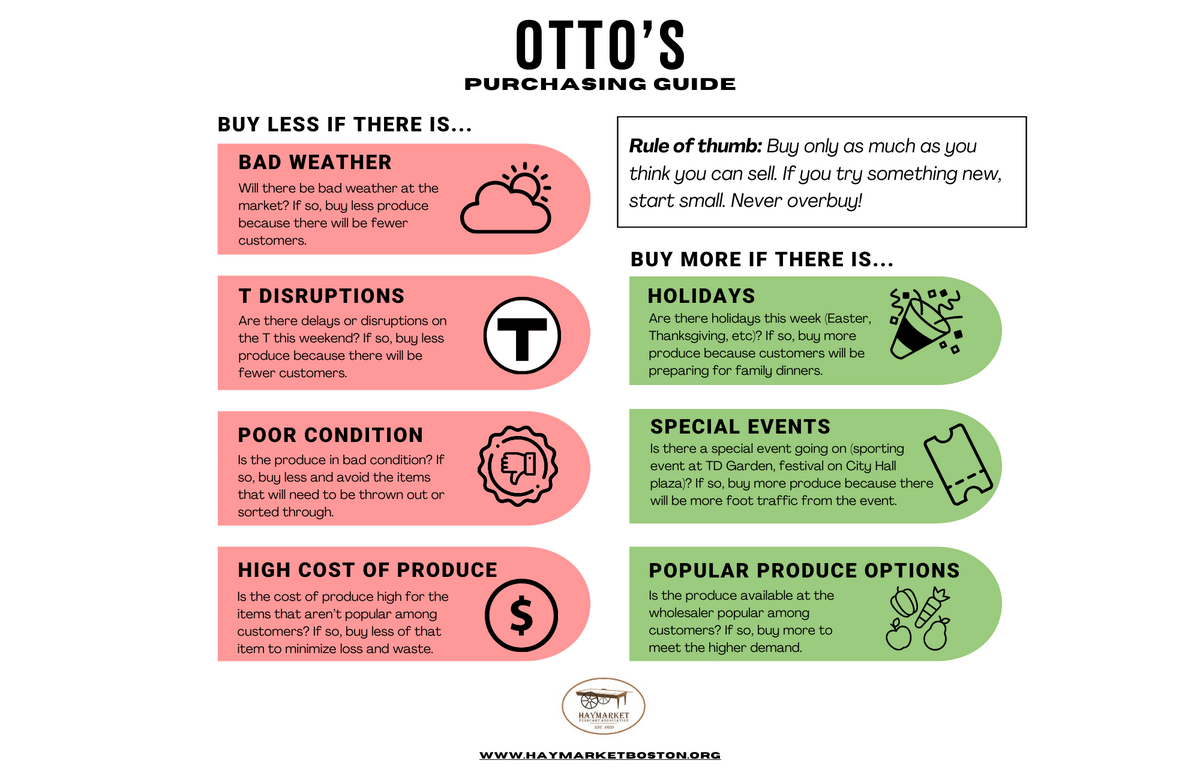
Food Recovery: We helped to connect the HPA with the newly developed Greater Boston Collaborative Food Access Hub to distribute recovered food to communities across Boston.

We helped connect HPA with the newly developed Greater Boston Collaborative Food Access Hub. Food remaining at the end of the market is picked up and distributed to communities across Boston, often routed through the Hub. This initiative is one way we’re taking action on several recommendations from the Office of Food Justice’s Food Recovery Assessment. These efforts help reduce food waste and associated greenhouse gas emissions by increasing the scale of recovered food.
How We Did It
The Mayor’s Office of New Urban Mechanics team took a human-centered approach to this project, conducting many site visits to the market, working directly with vendors and market leadership, and bringing in experts on waste management and food recovery to help design the new tools and systems.
Watch this short video to learn about how we learned about how we approached this project:
Outcomes
Fresh surplus food being collected at Haymarket and the Greater Boston Collaborative Food Access Hub are a win-win for Boston, putting healthy and nutritious food on the tables of families in need while simultaneously reducing our City’s carbon footprint.


